Indeed data reveal a growing boom in labor demand for construction, installation, and engineering roles for data centers.
Key points:
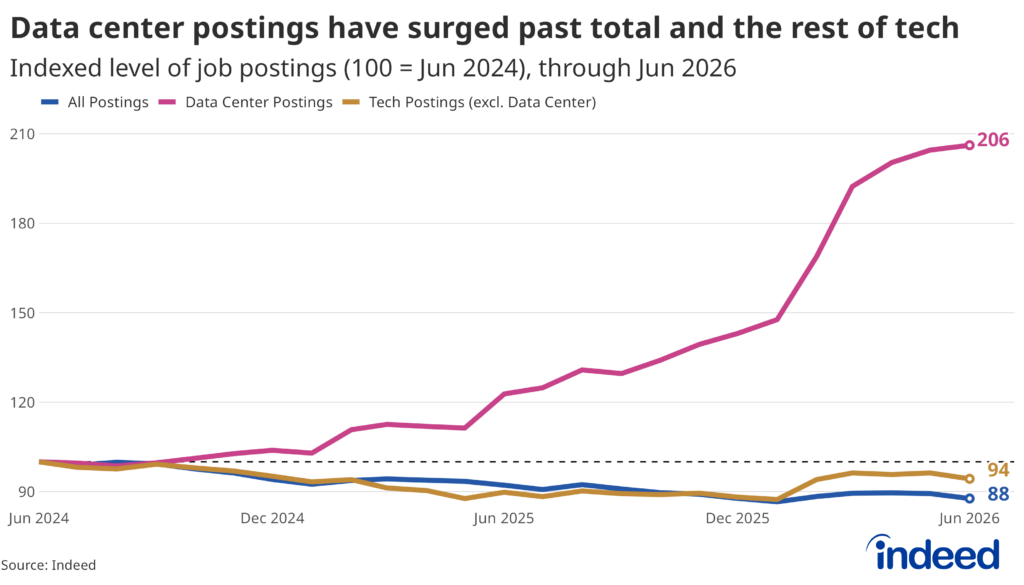
- Data center job postings have more than doubled over the last two years. Six in every 1,000 US job postings are now data center-related, up from 2 per 1,000 in May 2023.
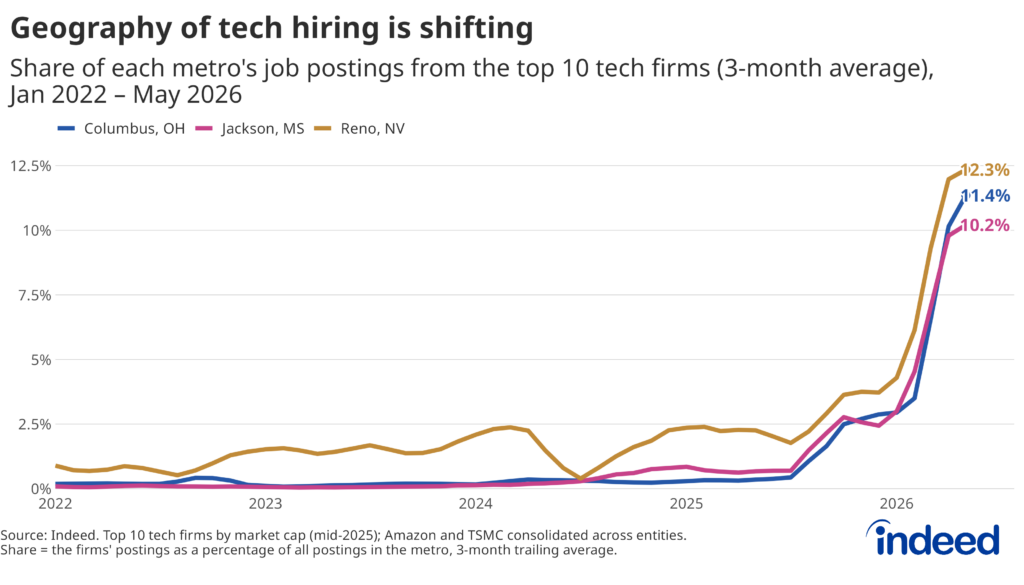
- The largest 10 tech firms account for 71% of data center postings in 2026, and their hiring footprint in smaller metros like Columbus, OH; Jackson, MS; and Reno, NV, has jumped from under 2% of local postings in mid-2025 to over 10% today.
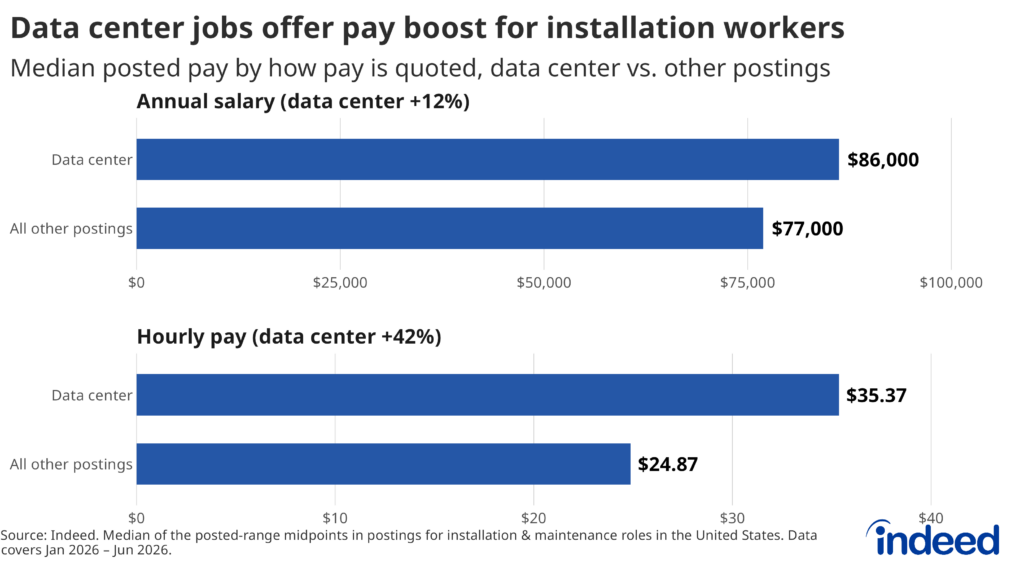
- About a quarter of all data center job openings are for installation and maintenance workers. And while these jobs do not pay as much as many traditional tech jobs, such as software engineers or developers, they do pay a premium: hourly installation workers at data centers can expect a 42% increase compared to non-data center pay, or ten dollars more per hour.
While AI has the potential to impact labor markets in many different ways, from task disruption to the creation of new jobs, much of the current discussion around AI’s impact on the labor force focuses on the ways in which the technology is, and will be, destroying jobs. But Indeed data show that AI is creating jobs too, and many of them are showing up in the same tech-related sectors, and amongst the same employers, that have been prominently featured in layoff announcements.
Under the surface, there is a growing boom in tech jobs that don’t look like tech jobs. These jobs in construction, installation, and management are all tied to AI’s backbone — the data centers that house the computer servers and store and route digital data. The build-out of data centers requires not only traditional tech skills but also specialized knowledge in construction, electrical systems, and engineering, changing the dynamics of hiring. The fascinating reality today is that many new employees starting jobs at the largest tech firms do not have (or need) traditional tech backgrounds.
Data center jobs are booming
Over the past two years, job postings for data center roles have more than doubled. Meanwhile, total job postings in the US fell roughly 12%, while postings for tech jobs other than data center jobs fell by 6% over the same period. Currently, about 6 in every 1000 job postings are related to data centers (up from just 2 per 1000 in June 2023).
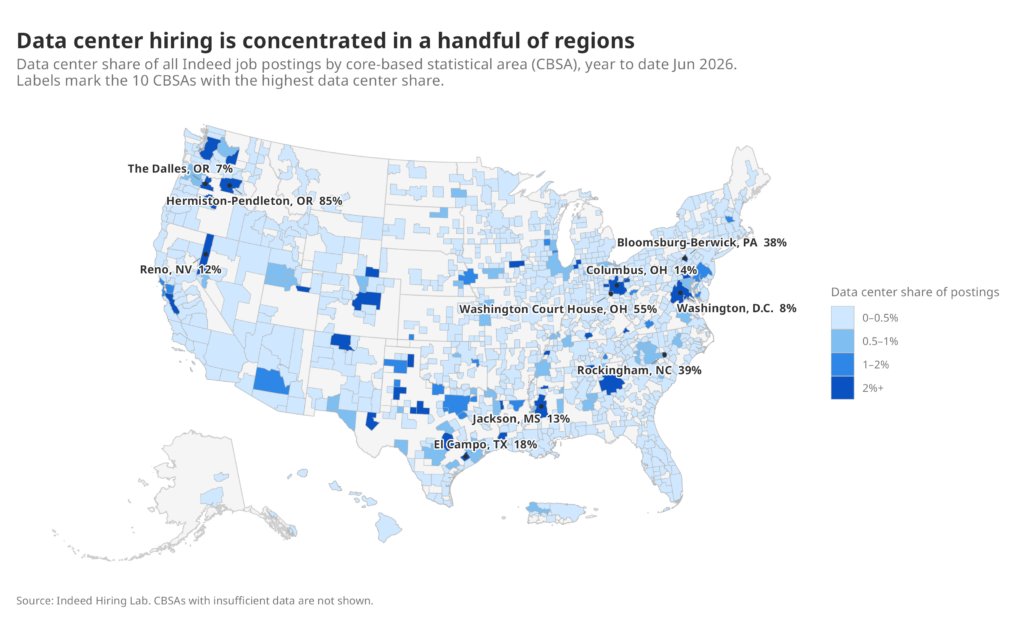
The 10 biggest tech firms (by market cap) account for 71% of data center postings thus far in 2026 and are buttressing labor demand for these jobs in specific regions related to the massive data center build-out. The areas where data center postings make up the largest share of total postings are towns where hyperscalers have established footholds, such as Hermiston, Oregon (one of the major AWS hubs); rural communities on the outskirts of Columbus, Ohio; Jackson, Mississippi; and Reno, Nevada. The Washington, D.C. area also stands out with 8% of total postings year-to-date coming from data center roles.
Historically, hiring by the largest tech employers has been heavily biased towards the large tech hubs across the US, such as Silicon Valley, Seattle, and Austin. The rise in data center employment is changing this. The share of job postings coming from the 10 largest tech employers has increased in places like Columbus, Jackson, and Reno, from less than 2% in mid-2025 to more than 10% today.
Not the tech jobs of yesteryear
With the lion’s share of labor demand originating from big tech hyperscalers, it is hard not to classify these jobs as tech jobs. But data center-related job descriptions read much differently from what one might typically picture for tech workers. This might not be surprising, given the massive amount of construction that is required to bring data center projects to life — private spending on data center construction has risen 23% over the past year, according to the US Census Bureau, with nearly $60 billion of data center spend in May.
A data center role is as likely to be an opening for installation & maintenance workers as for an IT professional (namely, network technicians). Roughly a quarter of all data center postings year-to-date have been for installation & maintenance workers as tech firms need workers to install the electrical and communication equipment, such as cabling, computers, and servers that data centers rely on. The share of installation & maintenance roles within data center postings is even higher in the key regional hubs of the data center build-out.
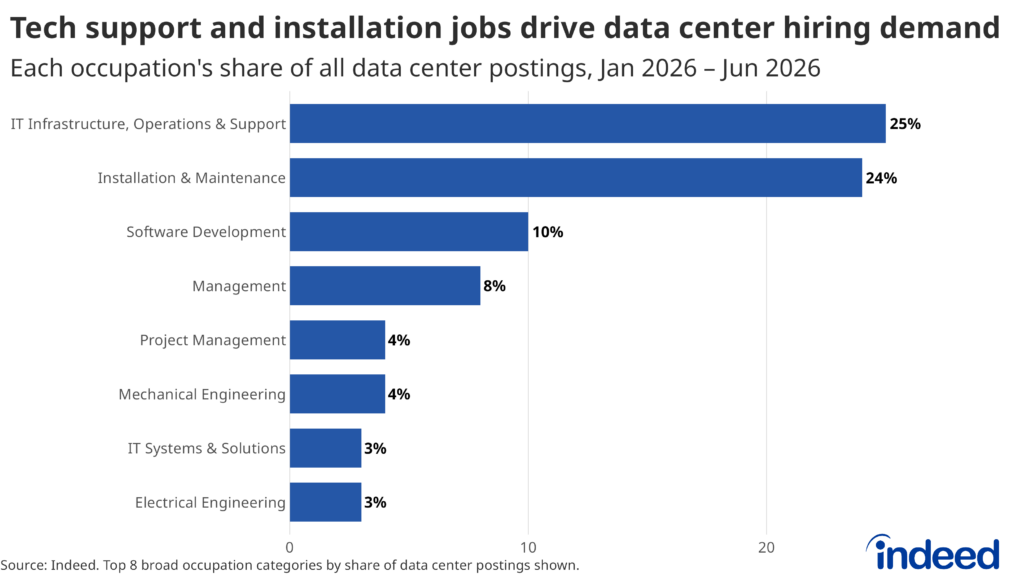
While much attention has been given to the decline in tech postings, especially within entry-level positions, our data point to considerable growth in some jobs. Over the past two years, there has been a notable increase in certain tech positions, many of which are directly related to AI. Several of these roles are directly related to the data center boom, including roles like Data Center Technician and Data Center Engineer.
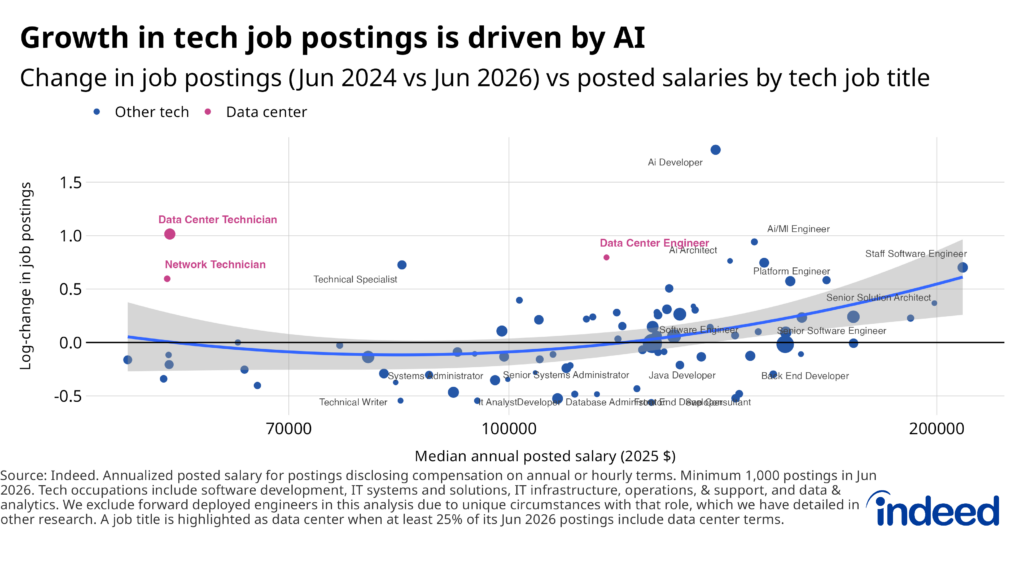
The occupational breakdown of data-center hiring means that even as AI is bolstering tech hiring, it is doing so in occupations with worse pay. Data center jobs tend to be lower-paying than many traditional tech jobs, such as software engineers or developers, while jobs in installation, maintenance, and construction tend to pay even less.
Still, even as AI-related hiring might be pushing toward a lower-paying occupational mix more broadly, for installation and maintenance workers, a job related to data centers does carry a nice wage premium. In roles that pay hourly, workers can expect to receive $10 more per hour working in a data center role compared to another installation & maintenance job unrelated to data centers.
Conclusion
As the AI rollout gathers steam, focus on labor-market dislocations has often centered around impacts on the tech sector. The technology sector has led layoff announcements in 2026 by a wide margin, with the information sector’s layoff rate increasing from 1.2% to 1.8% over the past year.
But Indeed data show that AI is also boosting some labor demand, even in tech. The AI build-out is reshaping tech hiring in ways that don’t fit the usual picture, and much of the new demand is for construction, installation, and maintenance workers, concentrated in a handful of metros, though paying less than the software roles that have long defined the sector.
Tech companies will need workers from many backgrounds and skill sets to keep the trains rolling, but questions remain about the surge in data center labor demand. For instance, what does data center employment look like once construction is complete? Will they be permanent once the center is up and running? Only time will tell.
Methodology
We track data center postings by tallying job postings on Indeed in the United States that include the term “data center”, “datacenter”, or “data-center” anywhere either in the job title or in the job description. This method doesn’t capture the full extent of data center labor demand and picks up roles that are not actually to do with data centers but whose job description may include the terms. Still, we believe this method provides a gauge of recent trends.
All figures are self-reported and reflect Indeed’s user base, which may differ from the overall US workforce.
The number of job postings on Indeed, whether related to paid or unpaid job solicitations, is not indicative of potential revenue or earnings of Indeed, which comprises a significant percentage of the HR Technology segment of its parent company, Recruit Holdings Co., Ltd. Job posting numbers are provided for information purposes only and should not be viewed as an indicator of performance of Indeed or Recruit. Please refer to the Recruit Holdings investor relations website and regulatory filings in Japan for more detailed information on revenue generation by Recruit’s HR Technology segment.