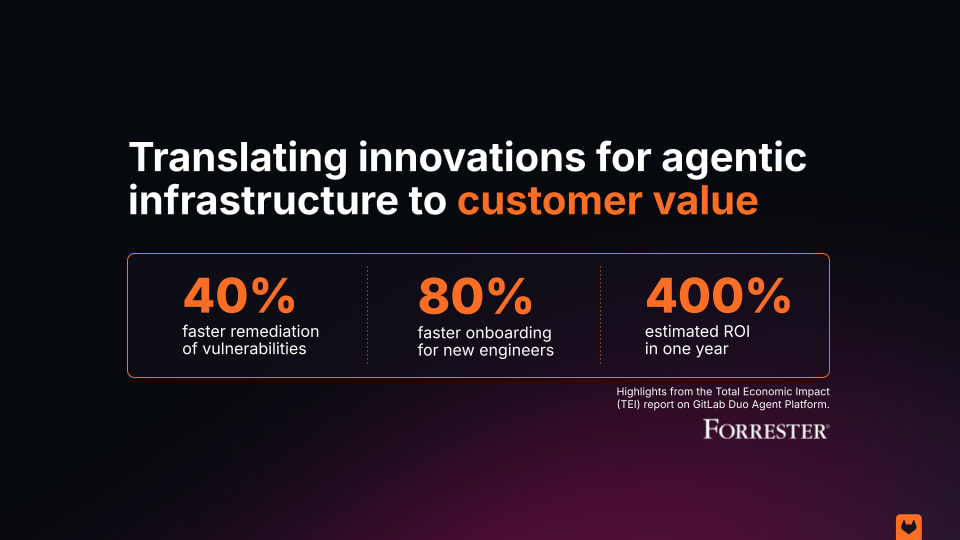
A new Forrester Consulting Total Economic Impact™ study found that organizations using GitLab Duo Agent Platform achieve a 400% return on investment and $7.5 million in net present value over three years — with payback in under six months.
Agentic coding makes developers faster. The harder problem is how enterprises turn speed into return. Faster commits are only part of the equation when it comes to shipping production-grade software. One senior systems engineer in insurance and financial services put it plainly: Code review that used to take hours now takes a fraction of the time, with 80% to 90% of code generation handled by the platform.
To help leaders understand returns achievable by using GitLab, Forrester interviewed four decision-makers across the financial services, software development, entertainment, and insurance industries who use GitLab Duo Agent Platform in production, then combined their experiences into a single composite organization: a global company with $3 billion in annual revenue and 3,000 employees, scaling from 150 to 250 GitLab Duo Agent Platform users over three years.
Weighing cost with ROI
The study is transparent about the investment required: three-year, risk-adjusted costs of $1.3 million in consumption credits and $589,000 in implementation and ongoing management, including internal labor for the pilot program, training, and support. Weighed against $9.4 million in benefits, that’s the basis for the 400% ROI and $7.5 million net present value.
Before: Manual tasks, interruptions, code review bottlenecks
Before adopting GitLab Duo Agent Platform, interviewees described familiar bottlenecks: teams that depended on manual processes, senior-engineer expertise, and ad-hoc knowledge sharing to build, review, and secure software. New hires couldn’t get unstuck without pulling a senior engineer off their own work. Security fixes sat in a queue until one of a handful of people with the right context had time to look at them. And code review, not writing code, was often the hindrance to shipping. These dependencies are what Forrester’s composite organization addressed, resolved, and measured.
Forrester quantified four benefit areas for the composite organization, totaling $9.4 million in risk-adjusted benefits against $1.9 million in costs:
New developers onboarded 80% faster. Instead of pulling a colleague off their own work, new team members used agentic chat embedded in their IDEs and repositories to get context to work through unfamiliar codebases and conventions on their own — a $582,000 savings.
A migration budgeted for eight months finished in two, a 75% reduction in timeline. The composite organization used GitLab Duo Agent Platform to diagnose pipeline failures and resolve issues in real time during a large-scale migration from an on-prem GitLab environment to GitLab SaaS, saving $157,000 in labor costs.
Security and QA engineers got 40% of their time back. QA and security engineers cut remediation time using GitLab Duo Agent Platform’s contextual explanations and suggested fixes, reducing their dependence on senior engineers — a $1.3 million labor savings over three years.
Every developer got 20% more of their week back for feature work. Agentic chat and AI agents took over code review, testing, and troubleshooting that used to eat into build time — a $7.4 million combined gain across all developers as adoption grew over the three-year span.
Forrester also identified benefits it didn’t quantify for this study, including savings from consolidating overlapping AI development tools, improved developer satisfaction, and better cross-team knowledge sharing.
“Feature releases that used to take a couple of weeks are now completed in a couple of days. So we’re seeing high multipliers of productivity.” – Head of automation at a financial services company
Compounded returns for shipping secure software faster
The interviewees didn’t just code faster, they shipped features in days instead of weeks, remediated vulnerabilities in minutes, onboarded new hires in a fraction of the time, and compressed an eight-month migration into two months. The pattern this study captures is that while agentic coding accelerates individual output, the return only compounds when that speed runs through infrastructure built for the full software lifecycle.
If you’re building the business case for agentic infrastructure for software engineering at your own organization, this study gives you a framework grounded in what four enterprises actually did, so you can turn forecasts into reality.
Read the full Forrester Total Economic Impact™ study of GitLab Duo Agent Platform to see the complete methodology, financial model, and interview findings.
This study is commissioned by GitLab and delivered by Forrester Consulting. It is not meant to be used as a competitive analysis. Forrester makes no assumptions as to the potential ROI that other organizations will receive; results are representative of the experiences of the interviewed organizations and the composite they inform. GitLab provided customer names for the interviews but did not participate in them, and Forrester maintains editorial control over the study’s findings.