Human-in-the-loop AI: Who owns the decision?
Many product managers rely on decision frameworks such as DACI, RAPID, and SPADE to clarify who recommends, approves, and owns a choice. These frameworks make complex decisions easier to navigate, but they were designed around human participants. They start to break down when AI shapes the analysis, recommendation, or final outcome.
AI may already summarize user research, prioritize opportunities, draft requirements, or recommend next steps in your workflow. However, when a team accepts an AI-generated recommendation without assigning a human owner, accountability starts to slip away.
You cannot tell stakeholders that an algorithm made the call and expect that to explain why the decision was made. Every AI-assisted decision needs a named human owner who can verify the evidence, apply business and customer context, challenge the recommendation, and defend the final choice.
Human-in-the-loop (HITL) decision-making gives AI a supporting role while keeping review, approval, and accountability with a person. In this article, you’ll learn how to match human oversight to the level of risk, add review and escalation points, and audit AI-assisted decisions before they affect your product or customers.
Why classic decision frameworks fall short with AI
Classic decision frameworks assume that all named participants are people. In DACI, for example, the driver coordinates the process, the approver makes the final decision, and contributors provide expertise. These participants can explain their input, challenge assumptions, and answer questions about the choice. AI can influence the same decision without being able to own any of those responsibilities.
You could list AI as a contributor because it summarized research, compared alternatives, or recommended a direction. However, that creates a false sense of ownership. AI can generate an explanation, but it cannot reliably account for how it produced a specific output, recognize context it was never given, or take responsibility when its recommendation is wrong.
When no one verifies the sources, tests the assumptions, or considers what the output might have omitted, AI effectively becomes the decision-maker even though no one formally gave it that authority. That creates an ownership gap. The team may act on the output, but no one can clearly explain what came from AI, what a human verified, or who approved the underlying tradeoffs.
To scale AI without losing accountability, you should treat it as a tool used by a named human participant, never as the role holder itself. For every AI-assisted decision, identify who will validate the output, make the final judgment, document the reasoning, and escalate uncertainty.
Human-in-the-loop decision-making adds that structure through deliberate review points, approval steps, and escalation paths. It allows you to benefit from AI’s speed without handing it ownership of the decision.
What is human-in-the-loop (HITL) decision-making?
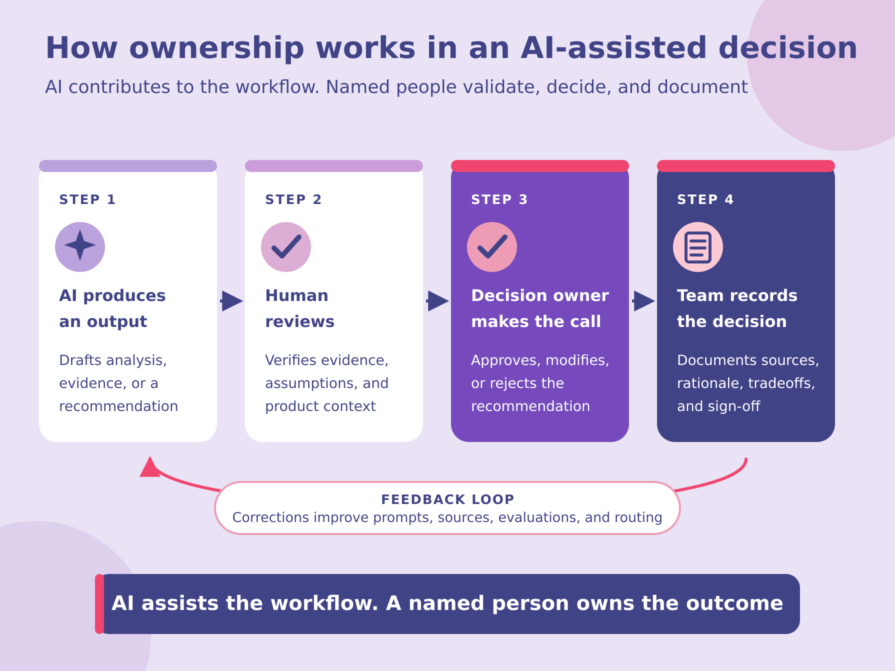
Human-in-the-loop (HITL) decision-making is an approach to AI-assisted workflows where a person reviews, guides, or approves an AI output before it drives a consequential action. Within this model, AI can synthesize information, identify patterns, or generate recommendations, but a named human remains responsible for the judgment and its outcome.
Human oversight can take several forms depending on the workflow:
- Approval checkpoints — The workflow pauses until a named person reviews and approves the output
- Confidence-based routing — Evaluation rules or system signals send uncertain, ambiguous, or anomalous outputs to a human for review.
- Escalation paths — Preset triggers transfer an issue to someone with the authority or expertise to resolve it
- Feedback loops — Reviewers document corrections so the team can improve prompts, source material, evaluation criteria, routing rules, or the underlying model
These controls add deliberate friction to the workflow. A human reviewer can verify the evidence, add product and customer context, consider ethical implications, and approve, modify, or reject the output. That reviewer doesn’t always have to be the product manager. Your responsibility may be to identify the appropriate decision owner and bring that person into the workflow at the right point.
Human review can create a feedback loop that improves future outputs. For that to happen, your team must incorporate corrections into prompts, source material, evaluation criteria, routing rules, or model training. Simply editing one output doesn’t teach the system or prevent the same mistake.
Here are a few examples of HITL in product workflows:
- Before moving an AI-generated epic into Jira, a product manager compares it with the source research and removes any unsupported requirements
- AI drafts a competitor analysis, but the product manager verifies its claims against official product pages, documentation, and other primary sources
- AI recommends which roadmap opportunity to prioritize, but the designated decision owner reviews the inputs and tradeoffs before accepting, modifying, or rejecting the recommendation
The appropriate level of oversight depends on the consequences of getting the decision wrong. A meeting summary should not require the same controls as a pricing or roadmap decision, which is why product managers need a consistent way to evaluate risk.
Use a decision-risk matrix to set human oversight
Not every AI-assisted task requires the same level of human review. As a PM, you should match the oversight to the potential impact of an error, how easily the error can be detected and reversed, and how much uncertainty surrounds the output.
Risk-based routing allows low-impact work to move quickly while reserving stronger controls for decisions that could affect customers, revenue, privacy, compliance, or company reputation. Use the following matrix as a starting point:
| Risk level | Consequences of an error | Product management examples | Appropriate AI role | Necessary human oversight |
| Low | The impact is limited, easy to detect, and easy to reverse | Organizing nonsensitive meeting notes, formatting backlog items, or generating a personal task list | Complete the task within established boundaries | Conduct periodic spot checks or review the output before it informs a more consequential decision |
| Medium | An error could create misalignment, rework, or a flawed internal recommendation | Drafting PRDs, generating user stories, synthesizing research, or grouping feature requests | Produce a draft, analysis, or recommendation | Verify sources, review assumptions, and edit or approve the output before it moves downstream |
| High | An error could harm customers or create financial, reputational, privacy, legal, safety, or regulatory consequences | Recommending pricing changes, evaluating launch readiness, or defining customer eligibility rules | Support research and analysis without approving or executing the decision | Add specialist, legal, or executive approval when appropriate, and preserve an audit trail of the inputs, output, rationale, and sign-off |
Don’t think of these examples as fixed classifications. The same type of work can move between levels depending on your unique context.
Before finalizing the workflow, use these three checks:
- What is the worst plausible outcome if the AI is wrong?
- How easily could the error be detected and reversed?
- Who is responsible for approving or escalating this decision?
When the answers are unclear, route the task to the higher risk level until your team has enough evidence to reduce the required oversight.
Common pitfalls in AI-assisted decision-making
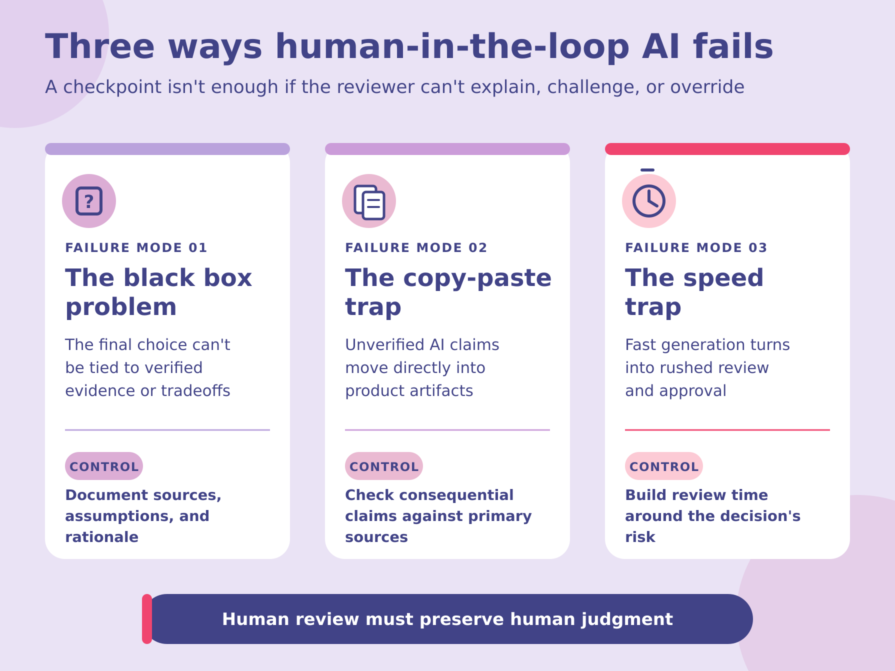
Adding a human checkpoint does not automatically preserve human judgment. If the reviewer cannot explain, challenge, or override the output, the human-in-the-loop process exists only on paper. As you integrate AI into decision-making, watch for these warning signs:
The black box problem
Stakeholders will eventually ask why a decision was made. “AI suggested it” identifies where a recommendation came from, but it doesn’t explain the reasoning behind the final choice.
If you can’t connect the recommendation to verified evidence, assumptions, and tradeoffs, you don’t have a defensible decision. Document what AI contributed, which sources a human verified, and why the decision owner accepted, modified, or rejected the recommendation.
The copy-paste trap
Copying an AI output into a PRD, roadmap presentation, or stakeholder update doesn’t transfer accountability to the tool. AI can fabricate claims, misinterpret data, omit important qualifications, or rely on outdated information.
More great articles from LogRocket:
Verify consequential claims against primary sources and remove anything you can’t support. Once you approve and use the output, its errors become your responsibility.
The speed trap
AI can shorten the time required to generate an analysis or recommendation, but it doesn’t eliminate the time needed to evaluate one. Faster output can create pressure to move directly from generation to action.
Build review time into the workflow, especially when a decision is difficult to reverse or could affect customers. The higher the risk, the more deliberate the review should be.
AI decision ownership checklist
Human oversight works best when it is designed into an AI-assisted workflow from the beginning. Use this checklist when auditing an existing workflow and before approving any medium- or high-risk output.
- Is this decision easily reversible if the AI output is wrong? If not, require human review and approval
- Is this a low-risk task? If not, apply the appropriate human-in-the-loop controls from the decision-risk matrix
- Does the AI output align with primary data sources? If not, reject or revise it. Correct the prompt, inputs, or source material before trying again
- Did AI encounter edge cases or ambiguous inputs that require human judgment? If so, pause the workflow and follow the established escalation path
- Can you explain why the final decision was made using verified evidence and clear tradeoffs? If not, gather the information needed to support the choice before proceeding
- Did AI make an error that required correction? If so, document the error and use it to update your prompts, trusted sources, evaluation criteria, or routing rules. Correcting one output doesn’t automatically prevent the same error from happening again
- Are you prepared to own the outcome if the AI-assisted decision causes a problem? If not, don’t approve it. If so, document who reviewed the output and who owns the final decision
Key takeaways
AI-assisted decisions need governance because their consequences still affect your team, products, and customers. Human oversight helps catch unsupported claims, missing context, and risky assumptions before they shape product outcomes.
Treat human review as a core feature of the workflow, not as a final check. Adapt decision frameworks such as DACI so AI remains a tool used within a human-owned role, then use the level of risk to determine when review, escalation, documentation, or sign-off is required.
By building intentional review points and feedback loops, you can benefit from AI’s speed while keeping judgment and accountability with a named person.
Featured image source: IconScout
LogRocket generates product insights that lead to meaningful action
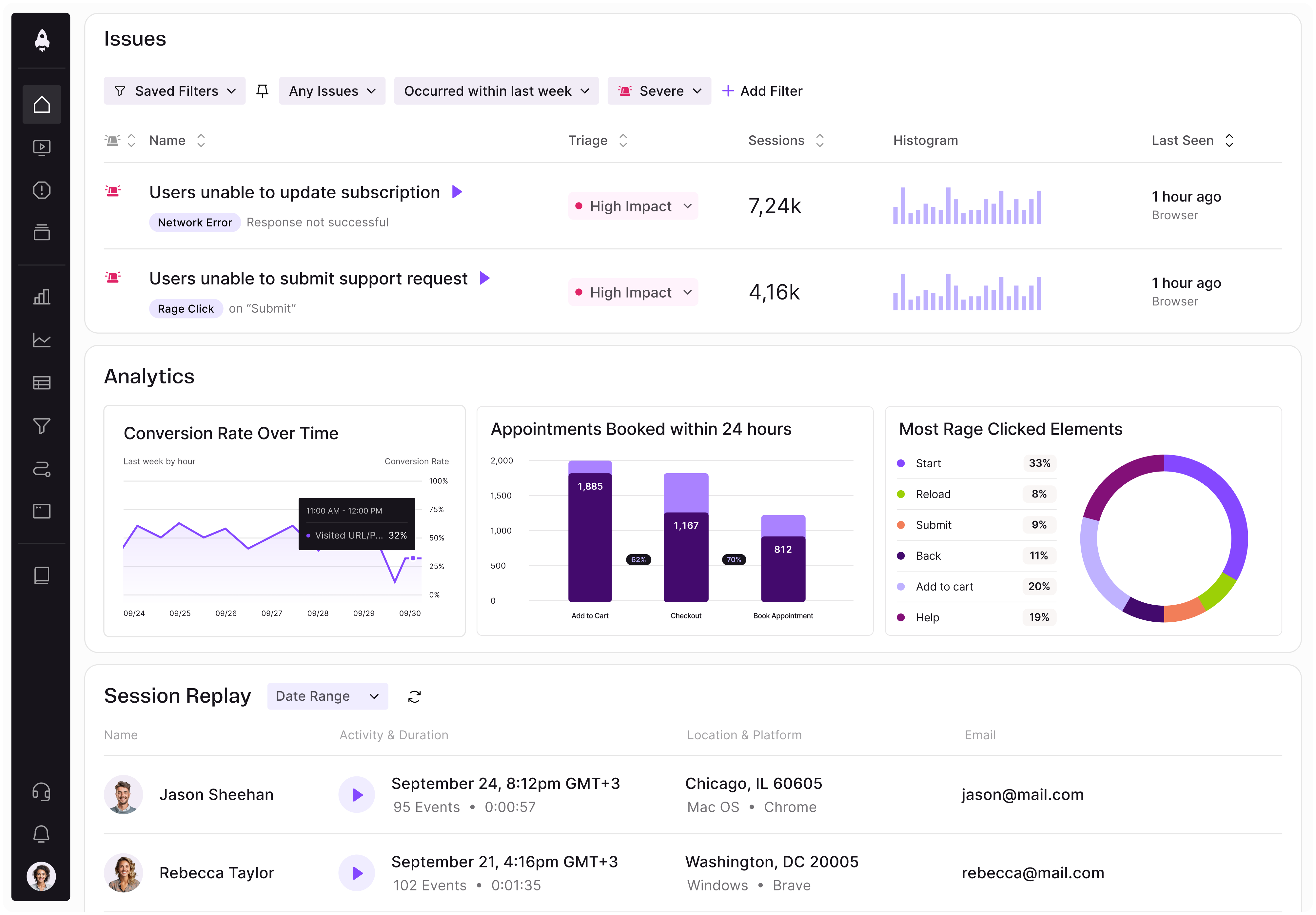
LogRocket identifies friction points in the user experience so you can make informed decisions about product and design changes that must happen to hit your goals.
With LogRocket, you can understand the scope of the issues affecting your product and prioritize the changes that need to be made. LogRocket simplifies workflows by allowing Engineering, Product, UX, and Design teams to work from the same data as you, eliminating any confusion about what needs to be done.
Get your teams on the same page — try LogRocket today.